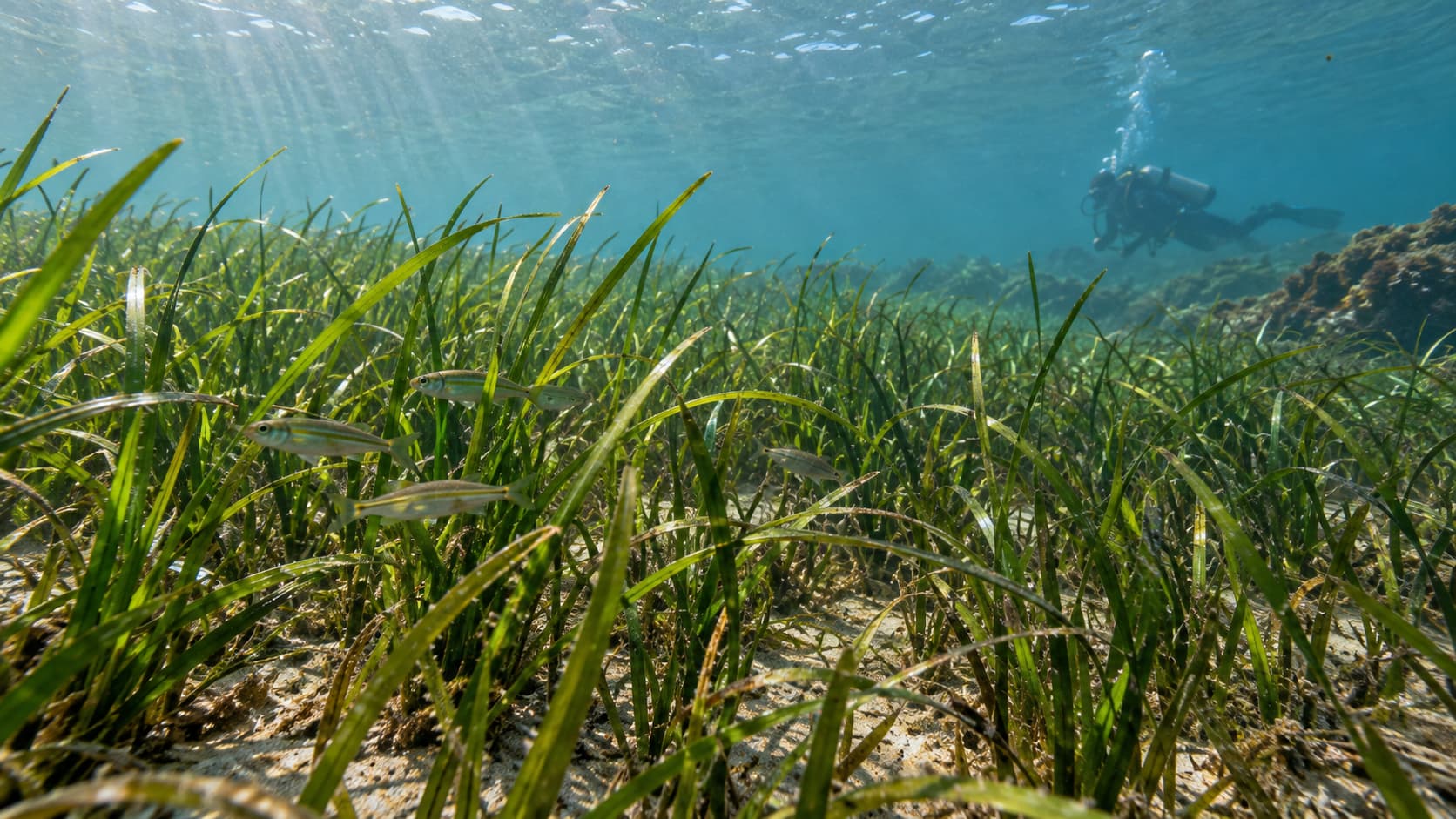
Beneath California’s coastal waters, patches of green vegetation are returning to stretches of seabed that were once nearly bare. These underwater meadows provide shelter for fish, stabilize sediments and support marine food webs. Unlike kelp forests, which consist of large algae, seagrass meadows are formed by flowering plants rooted in the seafloor. Their recovery has become an important objective for marine scientists working to repair damaged coastal ecosystems.
Recent restoration projects near Santa Catalina Island and the Channel Islands show that eelgrass can recover when suitable growing conditions are restored. Research published in 2025 and highlighted by UC San Diego in March 2026 documented the successful establishment of a new meadow along an exposed coastline. Meanwhile, additional projects launched in 2026 are addressing damage caused by boating infrastructure and investigating how different eelgrass populations respond to warmer water.
Why California’s Eelgrass Meadows Matter
Common eelgrass (Zostera marina) grows in shallow marine environments where enough sunlight reaches the bottom for photosynthesis. Its long, flexible leaves create a dense underwater canopy, while roots and underground stems secure the plants in soft sediments. These characteristics allow eelgrass to transform otherwise exposed stretches of seabed into complex habitats supporting numerous marine organisms.
Juvenile fish use the vegetation to avoid predators, while small crustaceans and other invertebrates find food and shelter among the leaves. Larger animals also visit these habitats to feed. Healthy meadows can reduce the movement of sediment, improving local water clarity and helping protect coastal environments from erosion.
Eelgrass contributes to coastal carbon storage as well. Some organic material becomes buried in the sediment beneath the plants, where carbon may remain for extended periods. However, the amount retained varies considerably between locations. Restoration does not automatically produce a measurable climate benefit, and researchers must examine sediment conditions before estimating long-term carbon storage.
California’s underwater meadows face several pressures. Coastal construction can alter currents and increase sediment disturbance, while polluted water reduces the sunlight available to plants. Boat anchors and mooring chains physically damage the vegetation. Marine heatwaves, storms and changing ocean conditions can further weaken surviving populations, sometimes preventing natural recovery even after the original disturbance has ended.
The Catalina Island Restoration Experiment
One of California’s most encouraging restoration results comes from Button Shell, on the northern coast of Santa Catalina Island. Historical records indicated that the area once supported a substantial eelgrass meadow, but monitoring found that the vegetation had disappeared by 2018.
Scientists from UC San Diego’s Scripps Institution of Oceanography and collaborating organizations investigated whether common eelgrass could be reintroduced successfully. Before planting, they studied water temperature, light availability, dissolved oxygen and conditions at nearby natural meadows. This assessment was important because transplanting vegetation into unsuitable habitat often leads to poor survival.
In June 2022, researchers collected healthy eelgrass from Ripper’s Cove and transported it to Button Shell. Divers transplanted approximately 8,400 shoots using two approaches: individual plants inserted into the sediment and bundles secured together. The researchers then monitored the restored area and compared its development with seven established eelgrass beds around the island.
Results reported in the scientific journal Estuaries and Coasts showed that the restored meadow expanded to approximately 0.18 hectares within two years. Its shoot density, leaf dimensions and fish communities became comparable to those observed in natural reference sites. By 2024, the new habitat supported diverse fish assemblages, demonstrating that transplanted vegetation could help rebuild more than plant cover alone.
Underwater cameras also recorded a green sea turtle visiting the restored habitat. This observation was particularly interesting because it showed that protected marine species could begin using the newly established vegetation relatively quickly.
The experiment does not guarantee that every exposed coastline can be restored successfully. Button Shell offered favorable environmental conditions, and the scientists carefully selected the planting location. Nevertheless, the findings challenge the assumption that eelgrass restoration must be restricted to sheltered bays and estuaries.
Protecting Meadows Around the Channel Islands
A separate restoration initiative began in July 2026 around Santa Cruz Island, within the Channel Islands National Marine Sanctuary and Channel Islands National Park. Unlike the Catalina experiment, this project directly addresses damage from vessel moorings and anchoring.
Traditional mooring systems sometimes use heavy chains that drag across the seabed as boats move with changing winds and currents. Over time, these chains can scrape circular patches through eelgrass meadows, destroying vegetation and fragmenting the remaining habitat. Two moorings were also lost during winter storms in 2024, increasing the need for boats to anchor directly in sensitive areas.
The project, administered through California Sea Grant and funded by the California Ocean Protection Council, aims to restore three damaged eelgrass sites. The National Marine Sanctuary Foundation and its partners plan to replace outdated moorings with less damaging alternatives, transplant eelgrass into affected areas and establish standardized monitoring procedures.
Researchers will combine underwater surveys with sonar mapping and satellite imagery to measure changes in the extent of the meadows. The project is scheduled to continue through June 2028. Its results are therefore still developing, and it would be premature to describe the restoration as completed.
The approach addresses an essential weakness in some habitat restoration efforts: planting vegetation without eliminating the activity responsible for its disappearance. Replacing damaging infrastructure offers the possibility of protecting new growth rather than repeatedly repairing the same patches of seabed.
Climate Resilience and the Future of Eelgrass Restoration
A major question remains unresolved: which eelgrass populations are most likely to survive as California’s coastal waters become warmer?
A research program running from July 2026 to June 2028 is examining this issue through ecological genomics. Scientists from The Nature Conservancy, the University of California, Davis, and collaborating institutions are studying eelgrass populations across six major California bay systems, from Humboldt to San Diego.
The project will investigate genetic differences associated with heat tolerance and use transplant experiments to evaluate how plants perform under warmer conditions. Researchers also intend to examine seasonal seed production and develop practical guidance for selecting planting material.
This work could improve restoration decisions that currently depend heavily on obtaining plants from nearby healthy meadows. Local sources may be well adapted to present conditions, but their ability to tolerate future warming cannot always be assumed. Genetic research may help identify suitable populations while reducing the risk of poorly matched transplants.
Another 2026 initiative on Catalina Island focuses on restoring approximately 1.3 acres of Pacific eelgrass (Zostera pacifica), a different species from the common eelgrass studied at Button Shell. The project will combine planting with environmental measurements, time-lapse cameras and fish surveys. It will provide additional evidence about the conditions required for long-term recovery along California’s open coastline.
These projects illustrate why restoration success cannot be measured simply by counting transplanted shoots. Scientists also need to know whether the plants spread naturally, whether fish return, and whether the habitat can withstand storms, warmer water and other disturbances over several years.
The return of California’s seagrass meadows depends on protecting suitable habitat as much as planting new vegetation. The Catalina experiment demonstrates that recovery can occur relatively quickly under favorable conditions. The newer Channel Islands and statewide research programs will help establish whether those results can be sustained and repeated across different coastal environments.